
.png)
Introduction
Welcome to our exploration of NoSQL databases! With this blog, we will dip into the arena of NoSQL databases, also known as non-relational databases. If you’re familiar with traditional relational databases like MySQL or PostgreSQL, you’ll find that NoSQL databases offer a different approach to storing and managing data. Let’s dive in and apprehend the several kinds of NoSQL databases & their key features.
Types of NoSQL Databases
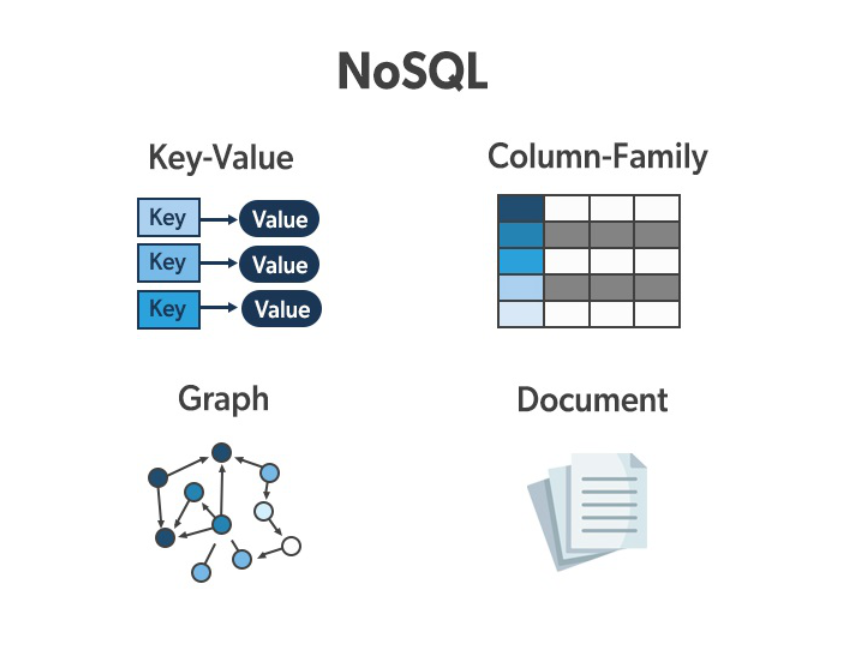
Key-Value Database
Key-value databases are the most straightforward form of NoSQL databases, where all data items are kept as a key-value pair. This means that each piece of data is linked with a distinct key, permitting quick retrieval. These databases excel in scenarios where you need fast and predictable performance for simple read-and-write operations. Key-value databases offer high scalability, making them suitable for applications with rapidly growing data needs, such as caching and session management in web applications. Instances of key-value databases comprise Redis, Amazon DynamoDB, and Riak, each offering unique features tailored to different use cases.
Document Databa se
Document databases keep data in a format of semi-structured, basically employing JSON or BSON documents. Unlike relational databases, document databases allow you to store nested data structures within a single document. This makes them apt for keeping complex, hierarchical data. Document databases provide flexibility in schema design, allowing you to easily accommodate changes to your data model without requiring extensive migrations. MongoDB, Couchbase, and CouchDB are popular examples of document databases, offering robust features for handling diverse data types and querying nested structures efficiently.
Wide-Column Database
Wide-column databases, also known as column-family databases, are optimized for storing and retrieving large amounts of data across distributed systems. Unlike traditional relational databases, which keep data in columns & rows, wide-column datab ases maintain data in columns based on column families. This allows for efficient storage and retrieval of large datasets, making them well-suited for use cases such as time-series data or analytics. Wide-column databases offer high accessibility and fault tolerance, assuring data integrity even in the situation of hardware disruption as well as network partitions. Apache Cassandra, HBase, and ScyllaDB are popular examples of wide-column databases, offering scalable and distributed storage solutions for diverse workloads.